
WOVR Explained: How Written-Off Vehicles Shape the Australian Used Car Market
In Australia’s used car market, WOVR status is one of the most significant and most misunderstood factors influencing vehicle value, risk, and liquidity.
WOVR does not describe a type of car. It describes a historical classification applied to a vehicle after an insurer has declared it a write-off. That classification permanently alters how the vehicle is treated by insurers, financiers, buyers, and resale markets, regardless of how well the vehicle may later be repaired.
Understanding how WOVR functions is less about avoiding certain cars and more about understanding where risk is concentrated, how disclosure varies by sales channel, and why price alone rarely tells the full story.
What WOVR Represents in Market Terms
The Written-Off Vehicle Register (WOVR) is a national database that records vehicles declared a total loss by insurers due to damage, theft, or other events.
Once recorded, a vehicle’s WOVR status:
- remains permanently linked to its VIN (Vehicle Identification Number)
- is visible to insurers, regulators, and history providers
- materially affects resale demand and valuation
From a market perspective, WOVR creates a separate class of used vehicles, not illegal, but structurally different from non-WOVR cars.
Repairable vs Statutory Write-Offs
WOVR entries fall into two distinct categories, which behave very differently in the market:
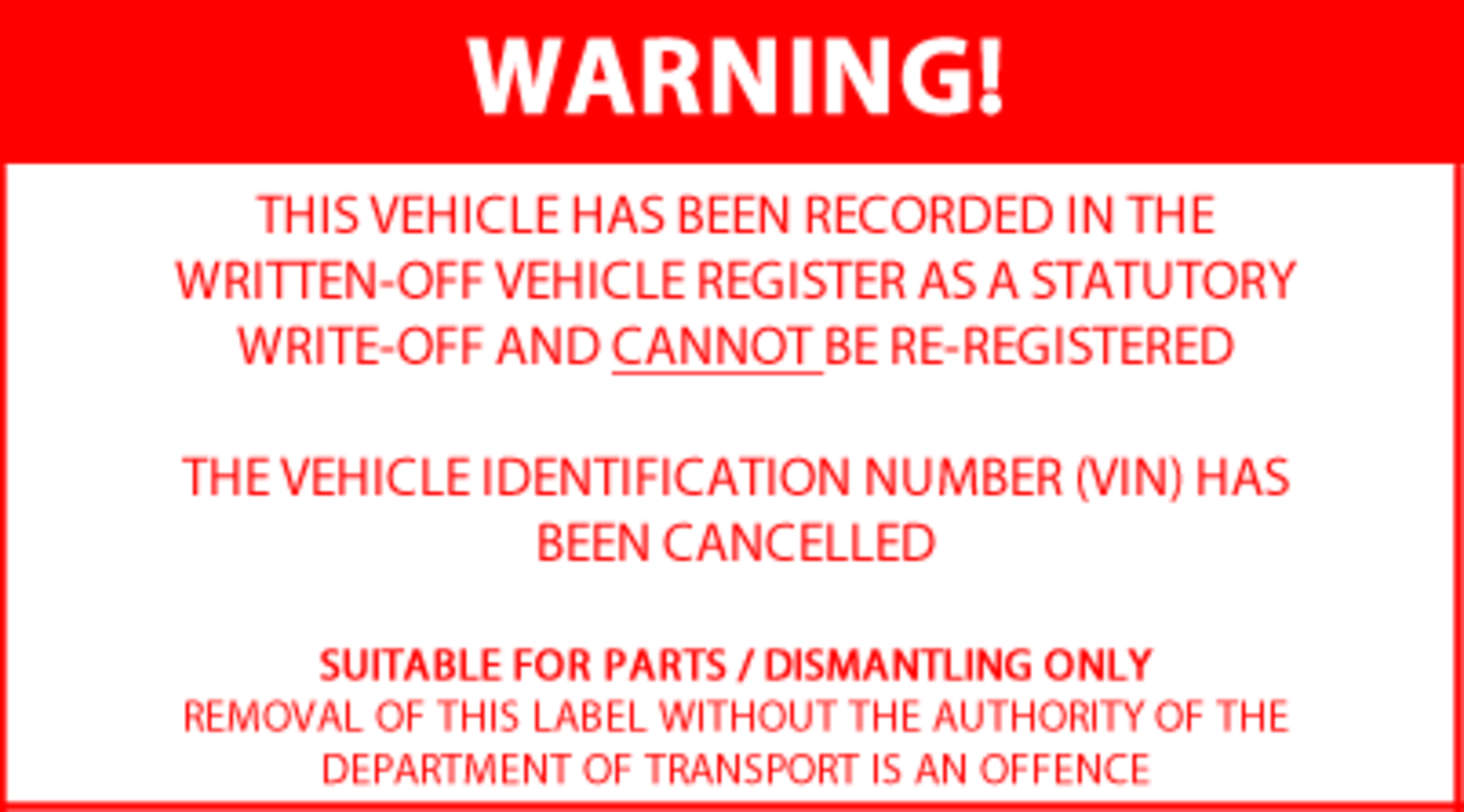
Statutory write-offs: These vehicles are permanently excluded from re-registration. They exit the consumer market entirely and are only relevant for parts or scrap.
Repairable write-offs: These vehicles may return to the road after repair and inspection, but their WOVR history remains visible indefinitely.
The used car market impact exists almost entirely within the repairable write-off segment.
Why WOVR Status Affects Value Long After Repair
Even when repaired to a high standard, WOVR-listed vehicles tend to experience:
- persistent price discounts relative to comparable non-WOVR vehicles
- narrower buyer pools
- more restrictive insurance terms
- reduced finance accessibility
- longer selling periods at resale
This is not necessarily a reflection of the vehicle’s current condition. It reflects information asymmetry and perceived risk.
Markets price uncertainty conservatively.
Where WOVR Risk is Concentrated
WOVR vehicles do not circulate evenly across all sales channels. They cluster where disclosure standards are weakest or least enforced.
Private Marketplaces
Peer-to-peer platforms, particularly Facebook Marketplace, represent the highest-risk environment for undisclosed WOVR vehicles.
Key reasons:
- no mandatory history verification
- limited enforcement of disclosure standards
- buyers relying on price signals rather than documentation
This is where most unintentional WOVR purchases occur, not because vehicles are illegal, but because buyers are unaware of what they are buying and often predatory sellers know they can get away with not disclosing a vehicle is a WOVR vehicle in most cases, often targeting vulnerable sellers.
Used Car Dealerships
Dealerships generally disclose WOVR status, but disclosure quality and honest conveyance of the potential impacts of a WOVR listed vehicle varies.
In market terms:
- reputable dealers price WOVR vehicles transparently and discount accordingly
- marginal operators may rely on buyer unfamiliarity rather than concealment
- disclosure may be technically compliant but practically understated
The issue here is not legality, it is buyer comprehension. Choose your dealer wisely. Always check online reviews and trust your gut.
Auctions
Auctions tend to be the most transparent environment for WOVR disclosure, but also the most unforgiving.
- WOVR status is typically declared in listings (as an example, Manheim Australia's auctions will clearly disclose WOVR status)
- buyer protections are limited
- pricing reflects wholesale risk tolerance
Auctions don’t eliminate risk, they price it openly.
WOVR is Not a Binary Quality Judgment
One of the biggest misconceptions in the market is that WOVR vehicles are either “bad cars” or “cheap bargains”.
In reality:
- some WOVR vehicles were lightly damaged (think hail) but uneconomical to repair at the time
- others suffered structural, flood, or complex damage that remains difficult to assess
- repair quality varies widely, even within the same damage category
The market does not punish WOVR vehicles because they are unsafe. It discounts them because outcomes are harder to predict.
Why Independent Checks Exist (and Why the Market Uses Them)
WOVR visibility relies on verification systems, not seller disclosure alone.
From a market standpoint, checks such as:
- PPSR searches
- state registration authority records
- vehicle history reports exist to reduce information imbalance between buyer and seller. One I have long trusted is a Car History Report for example, costs a little more, but on some cars it gives deeper insights.
They do not judge whether a vehicle is “worth buying”. They determine what category of risk a buyer is accepting.
When WOVR Vehicles Can Make Sense
In certain market segments, WOVR vehicles remain actively traded.
They may align with buyers who:
- plan long-term ownership
- are indifferent to resale liquidity
- understand insurance and finance constraints upfront
- price risk correctly rather than emotionally
In these cases, WOVR status is a pricing input, not a deal-breaker.
When WOVR Status Becomes a Problem
WOVR vehicles tend to cause issues when:
- buyers expect normal resale outcomes
- insurance limitations emerge after purchase
- finance assumptions prove incorrect
- disclosure is discovered late in the transaction
These outcomes are not mechanical failures, they are expectation failures.
The DriveWise View
WOVR vehicles are not an anomaly in the Australian used car market. They are a structural by-product of how insurance, repair economics, and risk pricing interact.
The real risk is not WOVR itself. The risk is misalignment between buyer expectations and market reality.
Understanding WOVR is less about avoidance and more about recognising how information, disclosure, and pricing shape outcomes and why some vehicles trade cheaply for reasons that persist long after repairs are complete.
Frequently Asked Questions
What does WOVR indicate in market terms?
WOVR indicates that a vehicle has been declared a total loss by an insurer at some point in its history. In market terms, it creates a permanent disclosure flag that affects valuation, liquidity, insurance, and resale outcomes.
Does WOVR automatically mean a vehicle is unsafe?
No. WOVR is a classification, not a current-condition assessment. Some vehicles are repaired to a high standard, while others carry ongoing uncertainty. The market discounts WOVR vehicles due to risk variability, not a universal safety judgment.
Why do WOVR vehicles trade at lower prices?
WOVR vehicles typically attract fewer buyers, face insurance and finance constraints, and carry resale friction. Markets price these factors conservatively, resulting in persistent discounts relative to comparable non-WOVR vehicles.
Where is WOVR risk most concentrated?
Risk is most concentrated in private sales where disclosure standards are weakest and buyers rely heavily on price signals rather than verified vehicle history.
Can WOVR status ever make economic sense for a buyer?
In some cases, yes. For buyers planning long-term ownership and pricing risk correctly, WOVR status can be a valuation input rather than a disqualifier. Outcomes depend on expectations rather than repair status alone.