
How Do Australian Fuel Efficiency Standards (NVES) Affect Car Prices in 2026?
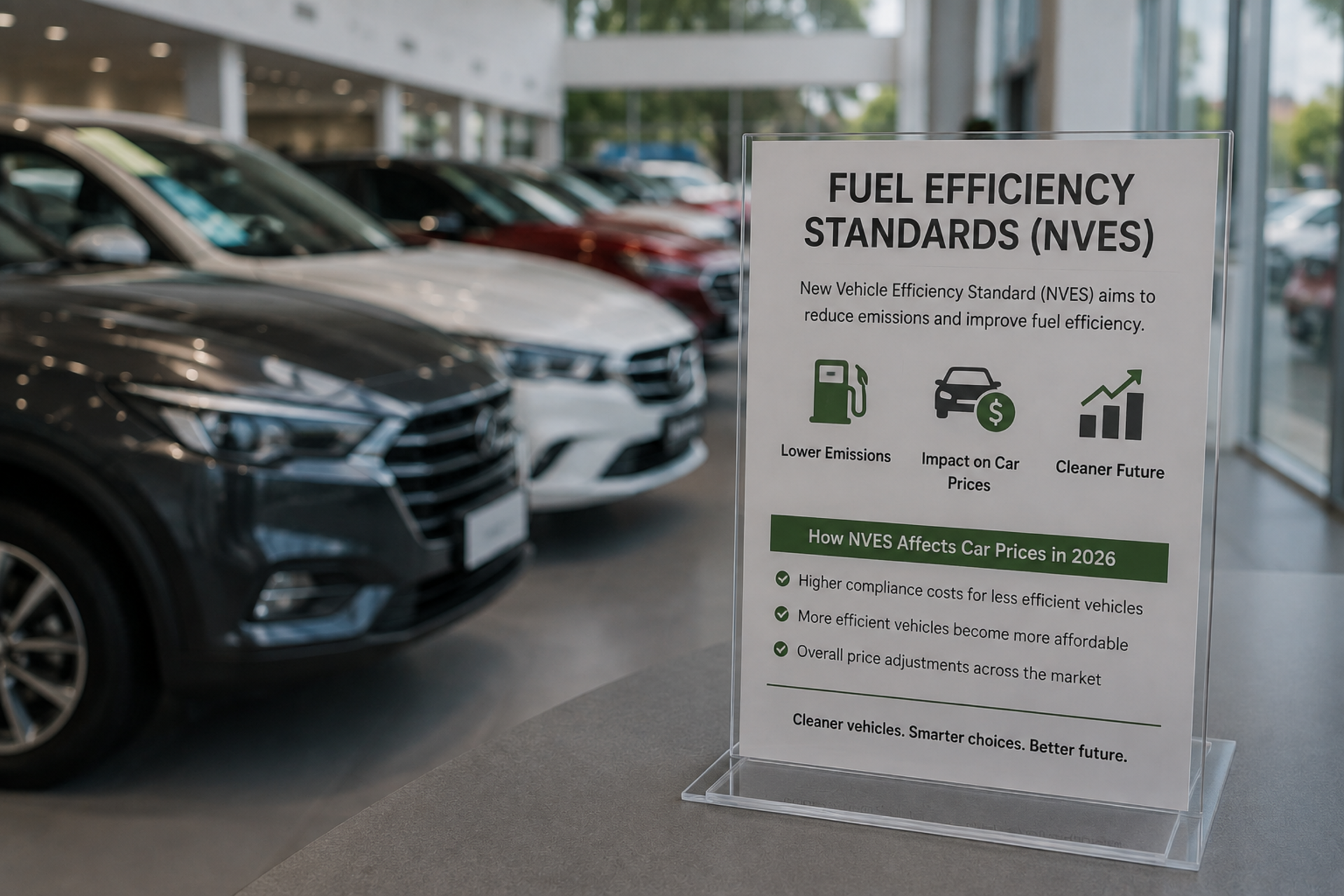
If you've noticed some new cars getting pricier and others getting cheaper through 2026, the New Vehicle Efficiency Standard (NVES) is a big part of the reason why. The NVES is Australia's first mandatory fuel efficiency scheme for new cars, and 2026 is the year its targets really start to bite. This guide explains exactly how fuel efficiency standards Australia wide are structured, how NVES car prices actually move up or down depending on the vehicle, and what NVES Australia 2026 means for anyone about to buy a new car.
What Is the NVES and How Does It Actually Work?
The New Vehicle Efficiency Standard is not a tax on buyers and it doesn't ban any particular car. Instead, it sets a fleet-wide average CO2 emissions target that every car manufacturer selling in Australia must meet or beat across everything they sell each year. The NVES started on 1 January 2025, with the first reporting period running from 1 July to 31 December 2025 and annual targets tightening every year after that.
• Type 1 vehicles - passenger cars, wagons and most SUVs and light 4WDs - face one emissions target.
• Type 2 vehicles - utes, vans and heavier off-roaders up to 4.5 tonnes GVM - face a separate, more lenient target.
• Manufacturers that beat their target earn credits; manufacturers that miss it accrue a financial penalty of $100 per gram of CO2/km over the limit in the first 12 months, dropping to $50 per gram from the second 12-month period onward, multiplied across every vehicle they sell.
• Credits can be banked, carried forward, or traded to another manufacturer, which is why some brands face almost no cost impact while others face very large bills.
Why Was the NVES Introduced?
The Australian Government's stated goal for fuel efficiency standards Australia wide is to cut emissions from new passenger cars by more than 60% by 2030, roughly halve emissions from new light commercial vehicles over the same period, and save motorists an estimated $95 billion in fuel costs by 2050. Australia was one of the last developed markets without a scheme like this, meaning many efficient models, including some hybrids and EVs, were previously sent to other countries first.
How NVES Targets Are Tightening: 2025–2029
This is the part that matters most for 2026 pricing - the passenger car target has already dropped sharply since the scheme's soft-start period, and it keeps dropping every year.
| Year | Passenger Car Target (g CO2/km) | Light Commercial Target (g CO2/km) |
| 2025 (soft start) | 141 | 210 |
| 2026 | 117 | 180 |
| 2027 | ~95 (indicative) | ~150 (indicative) |
| 2029 | 58 | 110 |
The jump from a 2025 soft-start target of 141g/km to a 117g/km target in 2026 is why manufacturers are feeling real financial pressure this year for the first time. By way of comparison, a 58g/km target by 2029 works out to roughly 2.5L/100km on a combined-cycle basis, a figure very few petrol-only cars can currently reach.
Which Cars Get More Expensive Under the NVES?
Under NVES Australia 2026, the vehicles most exposed to penalties, and therefore most likely to see price rises, are large, thirsty, low-volume models where a manufacturer has little else in its range to offset the shortfall against.
| Vehicle Example | Estimated NVES Penalty (2026, indicative) |
| Large 4WD wagon (e.g. LandCruiser-class) | ~$1,700 per vehicle |
| V8 performance coupe (e.g. Mustang GT-class) | ~$14,000 per vehicle |
| 4-cylinder performance coupe | ~$7,300 per vehicle |
| Compact off-roader (e.g. Jimny-class) | ~$3,000–$6,000 per vehicle |
| Mainstream diesel ute failing its target | Several hundred dollars per vehicle, rising yearly |
These figures are indicative penalty exposures reported in early NVES modelling for 2025–2026, not confirmed retail price increases - a manufacturer with enough credits banked from EV or hybrid sales elsewhere in its range can absorb some or all of this cost without touching the sticker price.
Which Cars Get Cheaper, or Stay the Same?
• Hybrids and EVs generate NVES credits rather than penalties, so manufacturers have a direct financial incentive to price them competitively and bring in more affordable models.
• Brands with EV-heavy or hybrid-heavy ranges, most notably Tesla, BYD and Toyota, are reported to be accumulating large credit surpluses that can offset penalties elsewhere in their lineup, keeping their own model prices stable.
• More than 60 new EV models are expected to reach the Australian market over the life of the scheme, with a growing number of sub-$60,000 options, which should keep downward pressure on EV pricing even as NVES targets tighten.
The Credit Trading System: Why Toyota and Tesla Are Winning
One of the least understood parts of how NVES affects car prices is credit trading. A manufacturer that beats its target, spreading a small number of penalty-attracting models across a very large volume of efficient hybrids or EVs, can end up with millions of dollars in spare credits. Toyota's hybrid-heavy range is a widely cited example: its scale lets it absorb penalties on a handful of thirsty models while banking substantial credits from the rest of its lineup. Tesla, selling almost entirely EVs, has been reported to be sitting on a credit surplus large enough to sell to other manufacturers rather than needing to use it all itself. In the first NVES results covering July to December 2025, the industry as a whole posted a net surplus of roughly 15.9 million efficiency units, but that headline number hid sharp differences between brands - Mazda, Nissan and Subaru were named among the manufacturers facing multi-million-dollar liabilities, while brands with EV or hybrid-heavy ranges came out ahead.
Real Estimated Price Impacts in 2026
Estimates for how far the NVES could push up average prices vary sharply depending on who is doing the modelling and how manufacturers choose to respond.
| Source / Claim | Estimated Impact |
| Federal Opposition modelling (utes and SUVs) | Up to $12,000–$17,000 added by 2029, under certain assumptions |
| Industry-wide penalty forecast to 2029 | Around $2.8 billion in total NVES fines across manufacturers |
| Government position (DITRDCSA) | No confirmed evidence the NVES increases vehicle prices overall |
| Case example: Nissan Patrol Y62 | A reported $5,000 price increase, with NVES cited as a contributing factor |
The honest picture sits between these two extremes. The New Vehicle Efficiency Standard doesn't apply a fee directly to buyers, but individual, low-volume, high-emission models can and do get repriced, while efficient models get relatively cheaper or hold steady, which is exactly the outcome the scheme is designed to produce.
Government vs Industry: Two Very Different Claims
• The Federal Government's position is that fuel efficiency standards Australia wide bring more model choice, lower fuel bills over time, and that there is no confirmed evidence of a broad price increase across the new car market.
• The Federal Opposition and some industry bodies argue the scheme functions like a hidden tax, warning of price rises concentrated in utes, large SUVs and performance vehicles as targets tighten toward 2029.
• Some manufacturers, including BMW at one stage, argued for a delayed start, while others such as Tesla and Polestar publicly broke with industry lobby groups opposing the scheme, saying claims of broad price rises were overstated.
So, Will the NVES Actually Push Up Car Prices in 2026?
For most everyday buyers shopping hybrids, small SUVs or EVs, NVES car prices in 2026 are unlikely to move much, and in some cases will fall as manufacturers compete harder to sell efficient, credit-generating models. For buyers set on large, thirsty utes, big 4WDs or performance vehicles, NVES Australia 2026 is a genuine cost risk, particularly for brands without enough hybrid or EV volume elsewhere in the range to offset the penalty.
The practical takeaway on how NVES affects car prices is simple: the closer a model sits to its manufacturer's overall emissions target, the less its price is likely to move; the further it sits above that target with no offsetting credits, the more exposed it is to a price rise as the scheme tightens each year through to 2029.
Frequently Asked Questions
What is the New Vehicle Efficiency Standard (NVES)?
The NVES is a fleet-wide CO2 emissions target scheme for new cars sold in Australia. It started on 1 January 2025 and requires manufacturers to meet or beat an average emissions target across everything they sell, or pay a per-gram financial penalty.
Does the NVES directly charge car buyers a fee?
No. The NVES applies to manufacturers, not individual buyers. However, manufacturers facing penalties on specific high-emission models may pass some of that cost on through higher prices on those models.
Which cars are most likely to get more expensive under NVES in 2026?
Large, thirsty, low-volume vehicles such as big V8s, performance coupes and heavy 4WDs are most exposed, especially from brands that don't sell enough hybrids or EVs elsewhere in their range to offset the penalty with credits.
Will EVs and hybrids get cheaper because of the NVES?
They're likely to become relatively more competitive. EVs and efficient hybrids earn NVES credits rather than penalties, giving manufacturers a financial incentive to price them keenly and bring more affordable models to Australia.
How much tighter do NVES targets get by 2029?
The passenger car target drops from 141g/km in the 2025 soft-start period to 117g/km in 2026, and down to 58g/km by 2029 — a target roughly equivalent to 2.5L/100km combined fuel consumption.
Is there disagreement about whether NVES raises prices?
Yes. The Federal Government maintains there is no confirmed evidence of a broad price increase, while the Federal Opposition and some industry groups argue penalties will flow through to buyers, particularly for utes and large SUVs, by 2029.